MV-Tracker fine-tuning
PyTorch · Distributed training · Multi-view tracking
I fine-tuned MVTracker to track points across multiple camera views in a wider range of scenes. Starting from the released model, I built the data preparation, training and evaluation pipeline around a mixture of Perpetua, SYN4D and MV-Kubric. This work contributed the fine-tuned baseline in TAPVid-MV, which I co-authored.
Training across different scenes
The central problem was transfer: improving on a new dataset without losing the original model’s capabilities. I compared single-source fine-tuning with replay mixtures, checked intermediate checkpoints on external benchmarks, and used scene-disjoint validation. SYN4D validation was separated by environment, rather than by neighbouring sequences from the same setting.
The final 5,000-step recipe contained 40,000 training samples: 25% Perpetua, 25% SYN4D and 50% MV-Kubric. I combined ground-truth depth with estimated and confidence-filtered depth so training included imperfect geometry. Preprocessing aligned cameras, world-space tracks, depth and visibility, while deterministic manifests recorded the scenes, frames, views and points for each update.
Making the pipeline practical
I ran distributed training on Modal and profiled the complete loading-to-update path. Indexed image storage, asynchronous decoding and prefetching helped keep training supplied with data. I also moved sample planning ahead of GPU execution, making runs replayable and allowing the same workload to be checked across implementations.
The final execution used four training GPUs and two additional GPUs producing estimated depth. Keeping depth generation in a bounded queue allowed it to overlap with training without accumulating the entire dataset in memory.
Results
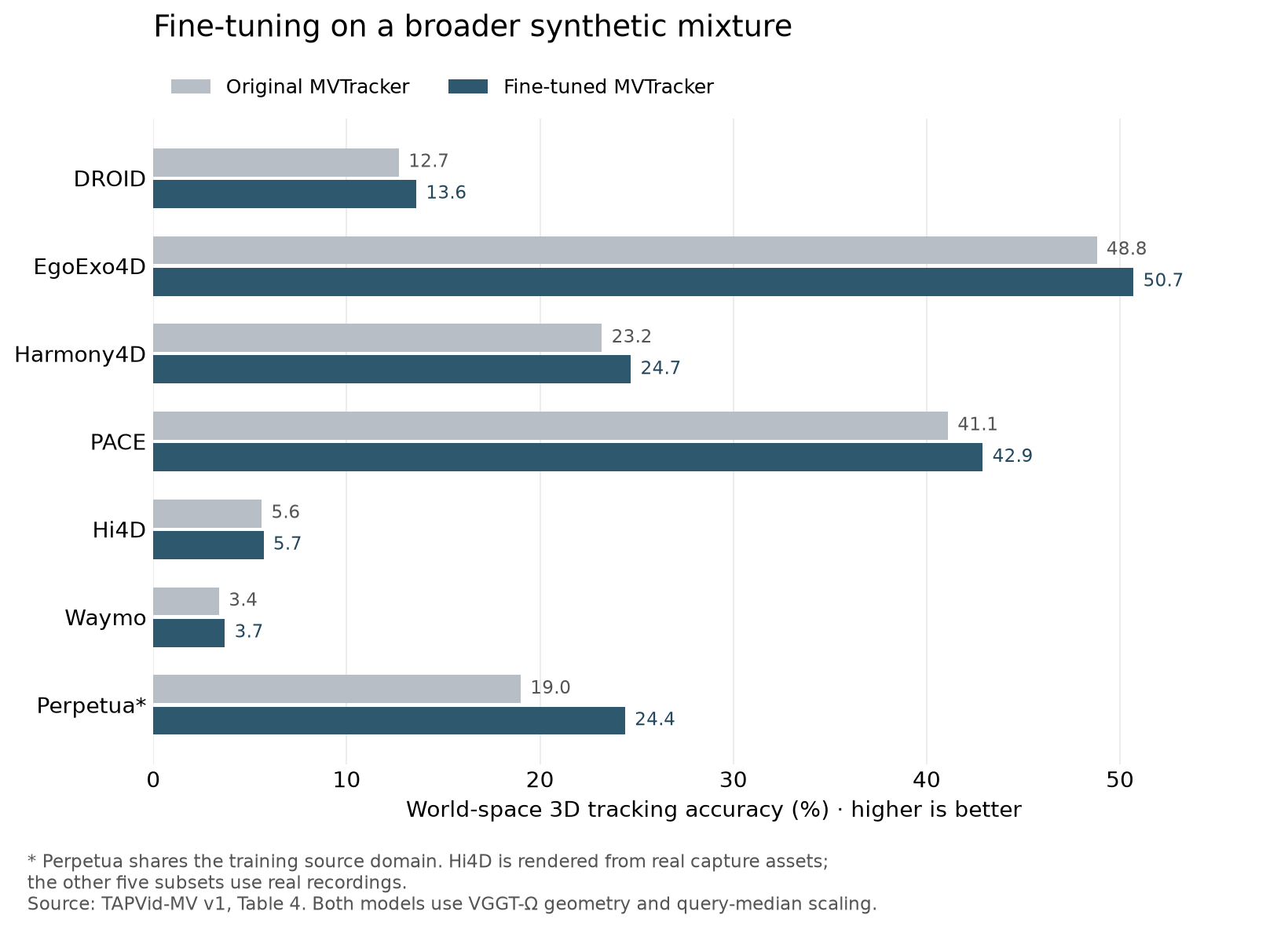
The published comparison shows higher world-space tracking accuracy on all six non-Perpetua subsets: five with real recordings, plus Hi4D rendered from real capture assets. Both versions use the same VGGT-Ω reconstruction and the benchmark’s query-median scaling protocol. The gains vary substantially by dataset; difficult scenes remain far from solved.